Kenya Aluminum Cookware Production Line Case: From Raw Materials to Stainless Steel Expansion
A Kenyan aluminum manufacturer began working with Sun Glory on an aluminum cookware production line in 2014. In 2025, it purchased stainless steel pot moulds and received technical support to explore a new product category using suitable existing equipment.

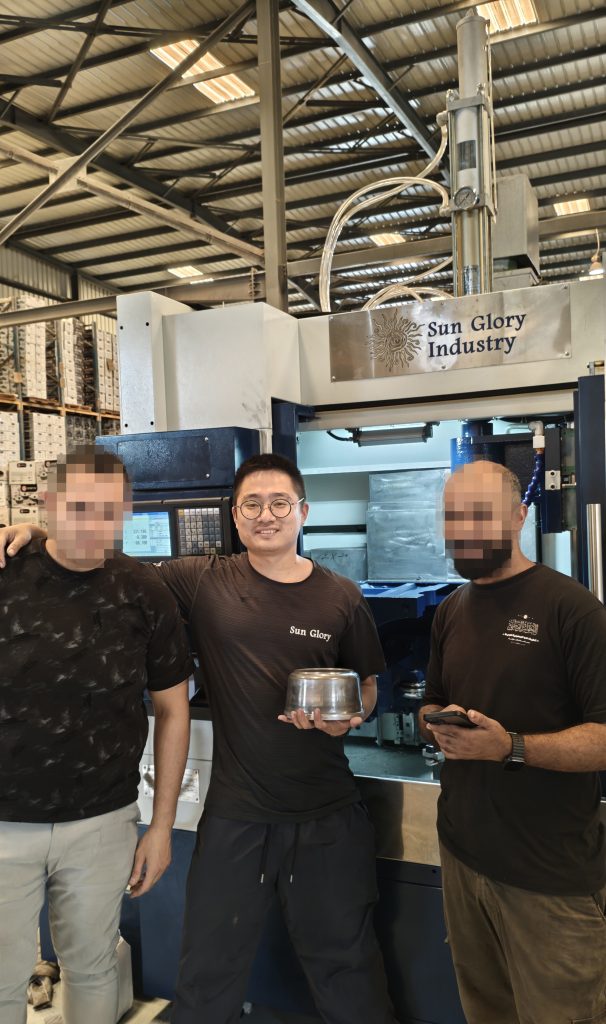
Starting as one of Kenya’s five major aluminum manufacturers, the customer worked with Sun Glory to move from aluminum raw materials into finished aluminum pot manufacturing. The partnership began in 2014 with a complete aluminum cookware production line planned around the product range, factory layout, installation, commissioning and operator training.
This customer case shows how coordinated cookware production machinery can support a raw-material business as it enters finished-pot manufacturing. In 2025, the customer purchased stainless steel pot moulds from Sun Glory for use with suitable existing equipment. Sun Glory also provided technical support on equipment suitability, mould matching and production planning. This approach helped the customer explore a new cookware category while making use of existing assets.
Customer background: one of Kenya’s five major aluminum manufacturers
The customer is one of Kenya’s five major aluminum manufacturers and a long-term Sun Glory partner. The business employs approximately 150 people and handles about 1,000 tonnes of aluminum per year.
Since the partnership began in 2014, Sun Glory has accompanied the customer for 12 years. The cooperation started with one complete aluminum cookware production line and expanded to factory-layout planning, production-flow design, operator training, additional machines, spare parts and finishing consumables. In 2025, the customer purchased stainless steel pot moulds to use with suitable existing equipment, with technical support from Sun Glory. This supported its exploration of a second cookware material category. The business path is significant for investors and channel companies because it connects upstream material capability, local manufacturing and an existing distribution network.
For broader market context, Kenya’s National Electric Cooking Strategy notes that Kenyan companies have begun manufacturing cookware and assembling electric cooking systems, reflecting the country’s developing local production base.
Kenya project at a glance
| Project aspect | Case details |
|---|---|
| Location | Kenya |
| Business background | Recycled aluminum and aluminum raw materials |
| Manufacturing development | Expansion into finished aluminum cookware and household products |
| Products in the customer’s business | Aluminum pots |
| Sun Glory’s support | One complete aluminum cookware production line supplied in 2014, plus layout and process planning, installation, commissioning and operator training |
| Continuing cooperation | Additional machines, spare parts, sandpaper and fiber wheels |
| Further expansion | In 2025, the customer purchased stainless steel pot moulds and received technical support for using suitable existing equipment |
The cooperation developed in three stages
Stage 1: establishing aluminum cookware manufacturing
The partnership began in 2014 with one complete aluminum cookware production line. Sun Glory supported factory layout, production-flow planning, installation, commissioning and operator training. This marked the beginning of a 12-year partnership focused on building and strengthening the customer’s finished-cookware manufacturing capability.

Stage 2: sustaining daily production
The relationship continued after the original line through individual machines, spare parts, sandpaper, fibre wheels and technical support. This stage matters because forming equipment alone does not guarantee a saleable pot. Finishing quality, maintenance routines, replacement parts and operator knowledge determine whether the factory can repeat an acceptable product.
Stage 3: stainless steel pot moulds and technical support
In 2025, the customer purchased stainless steel pot moulds from Sun Glory for use with suitable existing equipment. Sun Glory provided technical support on equipment suitability, mould matching and production planning. The cooperation covered moulds and technical support, helping the customer explore stainless steel cookware alongside its aluminum pots. The production process should be checked against the existing machines, target products, mould specifications and quality requirements.

From aluminum raw materials to aluminum pot manufacturing
Moving from aluminum materials into cookware adds new responsibilities: defining the product, organizing production, developing operator skills and maintaining a consistent finish. Access to materials is a starting advantage, but a finished pot must also meet the dimensions, appearance and functional expectations of its intended buyers.
In this Kenyan project, Sun Glory supplied an aluminum pot production line and supported factory layout and production process planning. Installation, commissioning and training formed part of the cooperation, helping connect the equipment with the customer’s day-to-day manufacturing work.
The customer developed aluminum pot manufacturing from its aluminum raw-material business. Different pot shapes, sizes and specifications require suitable tooling and production processes, so the target product range remains an important input to equipment selection.
For businesses considering a similar move, the first engineering discussion should begin with product samples or drawings, intended selling channels and expected order quantities. These inputs give a machinery supplier a basis for defining the production scope.
Why the partnership continued after the first production line
The cooperation extended beyond the original line purchase. The customer continued sourcing individual machines, spare parts and finishing consumables, including sandpaper and fiber wheels, to support its aluminum products business.
This is a useful consideration for any cookware factory proposal. Purchasing a line creates an ongoing requirement for maintenance, replacement parts, consumables and people who can operate the equipment. Buyers should establish how these needs will be handled while comparing machinery quotations.
For example, ask which wear parts should be stocked at the factory, how replacement parts are identified and ordered, and what support is available when operators encounter a process problem. Include training for the people responsible for setup and maintenance, alongside training for daily operation.
The Kenyan case illustrates a continuing equipment and service relationship. Its documented outcome is the development of local finished-product manufacturing and subsequent product expansion; it does not establish a universal production rate or financial return for another factory.
Why this Kenyan manufacturer had a stronger foundation than a typical first-time investor
The customer did not begin with equipment alone. Its experience in aluminum raw materials provided a practical foundation for moving into finished aluminum pot manufacturing, including material knowledge, factory operations and product planning.
A new investor without those assets should first define who will buy the cookware, which products will be launched and who will run production. A distributor or supermarket group can use order history and customer feedback as inputs. An existing manufacturer can begin with a capability audit of machines, tooling, people and quality controls.
What this case means for three types of buyers
Investors entering cookware manufacturing from another industry
For an investor with capital and experience in another sector, the priority is to define a manageable manufacturing business. Start by selecting the products and customers the first phase will serve, then identify the production team, facilities and technical support needed to deliver them.
A useful project brief should answer:
- Which pot sizes and product types will be launched first?
- What evidence supports the expected order volume?
- Who will manage production, quality and maintenance?
- What factory space and utilities are available?
- Which responsibilities belong to the equipment supplier, and which belong to the factory owner?
The Kenya project shows how equipment supply, planning and training can support a move into finished products. A new investor should also budget for tooling, installation, initial materials, spare parts and working capital, with the scope of each item clearly stated in the proposal.
Distributors, importers, brands and supermarket groups
Businesses with established sales channels can use their order history to shape a manufacturing proposal. Repeat purchases, popular sizes, customer complaints and packaging requirements are valuable inputs when deciding what to produce locally.
| Buyer type | Useful input for a manufacturing plan |
|---|---|
| Established cookware brand | Product specifications, approved samples and consistency requirements |
| Distributor without its own brand | Repeat wholesale orders, preferred sizes and customer packaging needs |
| Importer | Current product costs, replenishment patterns and the volumes suitable for local production |
| Supermarket or retail group | Assortment plans, private-label requirements, delivery schedules and acceptance criteria |
Compare the cost of locally manufactured, saleable products with the landed cost of the products currently purchased. Include production losses, packaging, maintenance, inventory and distribution in that comparison. Channel access is valuable, but the factory proposal still needs a realistic production and operating plan.
These are applications of the Kenyan case to channel businesses; the featured customer itself had an aluminum materials background.
Existing aluminum and cookware manufacturers
For an established manufacturer, begin with the capability already available. Map the current product range, process sequence, equipment condition and operator skills before deciding whether the next investment should be an individual machine, a specific production stage or a new line.
The Kenyan customer’s continuing purchases show that expansion can include additional machines and ongoing production support. Its purchase of stainless steel pot moulds for suitable existing equipment also illustrates a practical route to exploring another material category.
An aluminum-to-stainless-steel expansion requires a separate engineering assessment. Existing equipment should be checked against the proposed products, moulds and process requirements before reuse is assumed. In this case, Sun Glory supplied stainless steel pot moulds and provided technical support on equipment suitability, mould matching and production planning.

How to define an aluminum cookware production line
An aluminum cookware production line is a coordinated set of equipment and operations configured to make specified cookware products. The scope depends on the starting material, product design, required finish and target output.
The following is a planning framework for a new project, rather than the equipment list installed at the Kenyan factory.
| Planning area | What to define before requesting a quotation |
|---|---|
| Product range | Samples or drawings, dimensions, thickness requirements, lids and handles |
| Starting material | The material form supplied to the factory and the operations included in the project |
| Forming and tooling | The production route and tools needed for each product family |
| Finishing | Required appearance and any surface-treatment specification |
| Assembly and inspection | Component fitting, product acceptance criteria and inspection responsibilities |
| Capacity and staffing | Saleable output by product, shifts, changeovers and operator requirements |
| Factory integration | Layout, utilities, material movement, installation and training scope |
Clarify the boundary between raw-material processing and cookware production. A business working with recycled aluminum does not automatically require every upstream processing operation to be included in its cookware machinery order. The agreed starting material and final product specifications determine that boundary.
Questions to resolve before committing to a factory project
Before placing an equipment order, align the commercial plan and the technical proposal around a defined product range. Request a clear equipment and tooling scope, factory requirements, training plan and agreed acceptance criteria.
Capacity discussions should identify the product being made, its specifications, shift length, staffing assumptions and allowance for changeovers. A headline machine speed alone does not describe the saleable output of an entire cookware factory.
For a channel business, connect that output plan to realistic replenishment orders. For a new investor, connect it to the team and operating resources available. For an existing manufacturer, connect it to the limitations of the current factory and the next products it intends to launch.
Evidence and responsible project evaluation
The customer case confirms the transition into aluminum pots, the partnership that began in 2014 and the purchase of stainless steel pot moulds with technical support from Sun Glory in 2025. It does not provide verified before-and-after figures for labor reduction, production efficiency, reject rate, sales growth or return on investment.
Capacity, staffing and investment returns must be calculated for each buyer’s products, factory conditions, shift pattern and operating team. The customer’s scale and 12-year development path provide a useful planning reference, while every new project still requires its own technical and commercial assessment.
Frequently asked questions
Can a company without cookware manufacturing experience start an aluminum cookware factory?
Yes, but it needs a defined product plan, capable production management and technical support. Equipment selection, installation, operator training and quality responsibilities should be planned together. The required investment depends on the agreed project scope.
Can an importer or distributor develop local cookware production?
Yes. Existing sales data can help define the first product range and expected order volumes. The business should then compare a realistic local production plan with its current sourcing model, including operating costs and working capital.
How much does an aluminum cookware production line cost?
A meaningful quotation requires product specifications, target output, starting material, automation preferences and factory conditions. Buyers should compare quotations with equivalent equipment, tooling, installation and support scopes. This Kenyan case does not provide a verified project investment figure.
Does the Kenya case prove a fully automatic production model?
No. The case supports an aluminum cookware manufacturing project with ongoing equipment and service cooperation. It should not be used as evidence of a fully automatic or unattended factory. Automation should be selected for the proposed products and operating team.
Can an aluminum cookware manufacturer expand into stainless steel cookware?
Yes, but the technical route depends on the existing equipment and target products. In 2025, this Kenyan customer purchased stainless steel pot moulds from Sun Glory for use with suitable existing machines. Sun Glory also provided technical support on equipment suitability, mould matching and production planning.
Discuss your cookware manufacturing project with Sun Glory
Sun Glory supported this Kenyan customer’s development from aluminum materials into finished household products through production equipment, planning, training and continuing service.
If you are entering cookware manufacturing, moving from distribution into production or expanding an existing factory, share your product samples, target monthly volume, sales channels and proposed factory location. Include any existing machinery and site information so the discussion can address the scope you actually need.
Explore Sun Glory’s cookware production line solutions or contact our team to discuss your project.