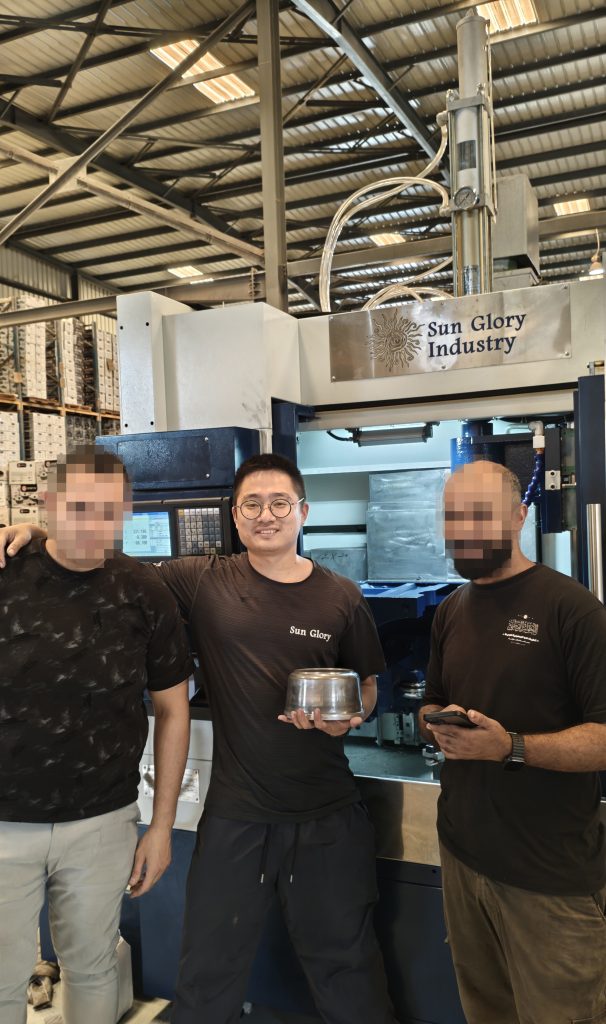
Multi-Head CNC Outer Polishing for Tri-Ply Cookware Manufacturing in India
Explore Sun Glory’s multi-head CNC outer polishing solution for tri-ply kadai and fry pans in India. Compare three-head and four-head configurations, see the finish transformation, and learn how to evaluate labour, consumables and productivity when upgrading your cookware production line.

For manufacturers producing tri-ply kadai and fry pans for the Indian market, a consistent exterior finish is an important part of product presentation and quality acceptance. Achieving that finish repeatedly requires a polishing process matched to the cookware’s shape, starting surface and production requirements.
A multi-head CNC outer polishing machine offers an approach to organising exterior finishing operations within one machine. The machine configuration can be customised around the customer’s cookware geometry, production flow and required surface effect.
For a new tri-ply cookware factory or an existing manufacturer upgrading its finishing process, the starting point is a representative cookware sample and an agreed finish standard.
What Does a Multi-Head CNC Outer Polishing Machine Do?
A multi-head CNC outer polishing machine is designed to process the exterior surface of suitable cookware bodies using multiple polishing heads and programmed motion. Its role is to help organise and repeat the selected outer-finishing process.
The actual configuration depends on the workpiece, incoming surface condition and required result. Before evaluating a machine, define the cookware shapes and sizes, exterior areas included in the process, required finish, acceptable appearance variation, and loading, unloading and inspection arrangements.
“Outer polishing in one machine” describes the agreed scope for a particular product. Inner polishing, etching and other manufacturing operations need their own process assessment.

Watch the Multi-Head CNC Outer Polishing Demonstration

How the Machine Supports a Consistent Polishing Finish
The programmed motion system helps repeat the approved polishing path for each cookware model. Automatic compensation can adjust for polishing-wheel wear, while controlled wax application supports a more stable finishing process.
Together, these functions help shift finish consistency from operator experience to validated process settings. The final result must still be confirmed through sample trials and an agreed acceptance standard.
Product Changeover for Kadai and Fry Pans
The machine can be configured for compatible kadai and fry-pan models. Product changeover is completed by replacing the corresponding fixture or mould and selecting the validated polishing program.
The required polishing sequence must be determined according to the complete production line, product geometry and target surface finish. Representative samples should be tested before the final process is approved.
How to Evaluate Surface Consistency
A bright sample is useful, but a repeatable acceptance method is also needed. The worldstainless guide to stainless steel finishes provides background on finish specification and reference samples.
- Agree which exterior areas will be polished.
- Compare parts under consistent lighting and viewing conditions.
- Define acceptable marks and appearance variation.
- Inspect several pieces from a trial batch.
- Record the setup and consumables used for the accepted result.
If a measured finish is required, agree the measurement method and acceptance limits separately. A photograph does not establish a measured surface-finish grade.

Why Is a Multi-Head Outer Polishing Machine More Suitable for Kadai and Fry Pans?
Kadai and fry pans combine curved walls, changing profiles and multiple exterior polishing zones. A programmable multi-axis motion system can follow a validated path around these surfaces more consistently than a process that depends mainly on manual positioning.
The actual tooling, polishing sequence and motion program are developed from representative samples, the incoming surface condition and the required finish. This allows the solution to be engineered for the cookware rather than relying on a one-size-fits-all process.
Automating outer polishing can help manufacturers explore reductions in manual handling, consumable use and processing time. The outcome depends on the existing process, workpiece and operating arrangement.
During production, one operator can supervise two to three of these machines. Compared with a semi-automatic double-station outer polishing machine, the proposed arrangement can reduce the staffing requirement by approximately three to four operators. The final labour plan should be confirmed against the factory layout, product mix, inspection method and shift arrangement.
Compare the same cookware specification and accepted finish. Record labour for loading, unloading, inspection and rework; polishing wheels, abrasives and compound consumed per accepted piece; accepted output over a defined period; and time spent on changeovers and maintenance.
This comparison helps establish cost per accepted piece. A shorter polishing cycle alone does not establish higher factory output if another operation remains the bottleneck.

Integrating CNC Outer Polishing into an Automatic Cookware Production Line
When planning an automatic cookware production line, evaluate how CNC outer polishing fits with upstream forming, workpiece handling and downstream inspection. Match the polishing stage to the intended product mix, required finish and output of the surrounding operations.
For a stainless steel cookware production line producing tri-ply kadai and fry pans, assess the polishing equipment as part of the complete process. Coordinate cookware production machinery around compatible workholding, transfer arrangements and changeover requirements so that each stage supports the next.
Plan polishing together with the upstream and downstream operations. Existing factories should assess incoming surface condition, workpiece flow and available space. New factories can consider finishing within the overall cookware production line plan.
Define movement between operations, tasks that remain manual, utilities, guarding and dust extraction, cleaning and inspection, operator training and maintenance access. Sun Glory’s factory planning and production support services can be discussed alongside the equipment proposal.
Related option: rotary outer polishing
A multi-head vertical rotary outer polishing machine is a different equipment arrangement from the CNC machine discussed above. Consider it as a related finishing option after reviewing cookware geometry, process sequence and handling needs.

Inner polishing is a separate operation
The interior surface has different access and tooling requirements. If both interior and exterior finishing are needed, define each operation and its inspection requirements within the production plan.

Lid polishing needs its own setup
Cookware lids differ from pan bodies in shape and workholding. Include representative lid samples and the required polishing areas when discussing a lid-finishing solution.

What Engineers Evaluate During Solution Design
- Representative cookware samples or drawings.
- Material structure, thickness, diameter, height and weight.
- The exact exterior areas included in polishing.
- Photos showing the incoming surface condition.
- An approved finish sample or clear acceptance requirements.
- Required polishing sequence and consumable expectations.
- Target output, shift pattern and product mix.
- Fixture or mould requirements for each cookware family.
- Existing equipment, factory layout, power, dust extraction and safety requirements.
- Whether automatic wax application or robotic loading and unloading are required; these must be defined during solution design.
This information helps determine the appropriate machine configuration, polishing sequence, tooling and supporting services.
Frequently Asked Questions
Can the machine polish both tri-ply kadai and fry pans?
Yes, when the two products are included in the application design. The polishing sequence is customised according to the complete production line and the required surface effect. Operators can change the product fixture or mould and select the corresponding program to switch between the two compatible products.
Does a multi-head CNC polishing machine require a robot?
A robot can be added according to the required loading, unloading and production-flow arrangement. The need for robotic handling must be raised and confirmed during solution design so that the machine layout, safety system and control program are engineered together.
Does outer polishing improve induction compatibility or heat distribution?
Outer polishing addresses the exterior surface finish. Induction compatibility and heat distribution depend on cookware materials and construction and require separate product evaluation.
Can every product be guaranteed a mirror finish?
The achievable finish depends on incoming condition, geometry, consumables and process settings. Define the target finish and agree sample acceptance before finalising the equipment specification.
How much labour can be saved?
One operator can supervise two to three machines during production. Compared with a semi-automatic double-station outer polishing machine, the proposed arrangement can reduce staffing by approximately three to four operators. Actual savings depend on the factory layout, product mix, inspection method and shift arrangement.
Discuss Your Tri-Ply Cookware Polishing Project
Whether you are planning a tri-ply cookware factory for the Indian market or upgrading an existing finishing process, start with your product and required surface effect. Share your samples, target finish and production requirements with the Sun Glory team to discuss a suitable CNC outer polishing configuration.